
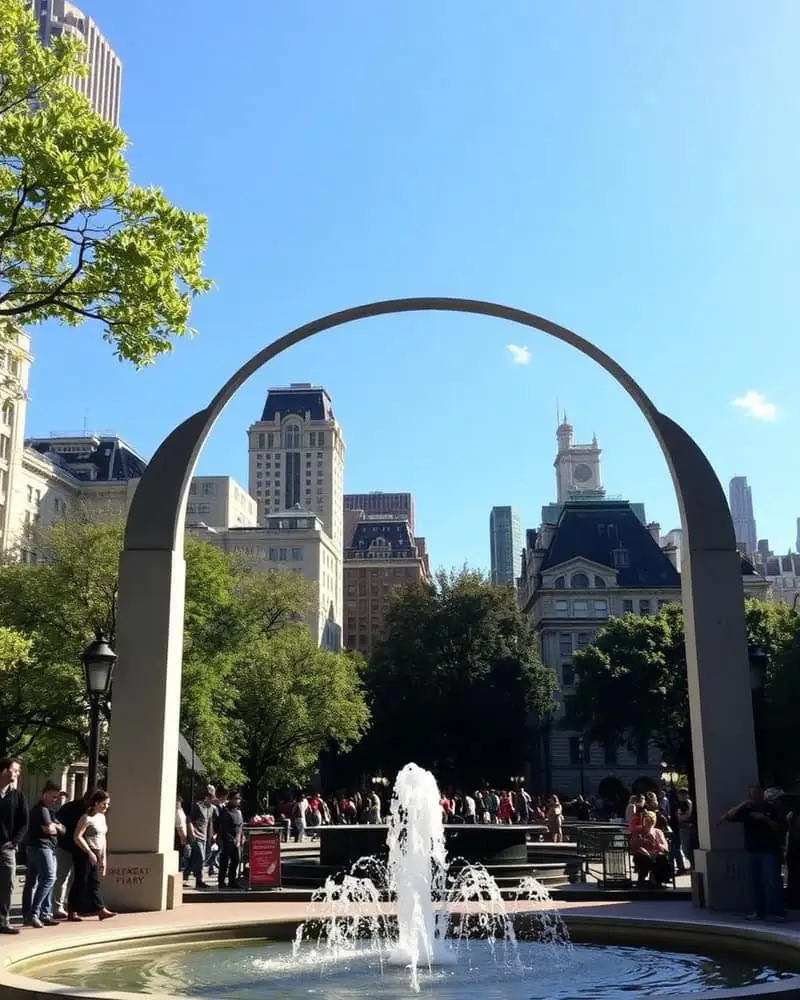
Washington Square Park covers 9.75 acres in Greenwich Village, right at the southern foot of Fifth Avenue. Few public spaces in the country carry this much history in this small a footprint — NYU students, chess players, street performers, protesters, artists, and tourists have all claimed it as their own since the 1830s. Underneath the lawns, an estimated 20,000 people are buried, remnants of its years as a public cemetery. The NYC Department of Parks & Recreation runs it now. It is free, and like most NYC parks it is open from 6am until 1am unless a sign at the entrance says otherwise.
The Washington Square Arch
The arch is the thing everyone pictures when they think of Greenwich Village — 77 feet of marble at the park's northern entrance, lined up perfectly with Fifth Avenue. Stanford White of McKim, Mead & White designed it, and the permanent marble version went up in 1892, replacing a temporary wooden arch from 1889 built for the centennial of George Washington's inauguration as the first President. Look closely at the north face and you'll find two carved relief panels: Washington in war on the eastern pier, Washington in peace on the western one. The arch is hollow inside, and in 1917 a group of artists led by Marcel Duchamp climbed up into it and declared Greenwich Village an independent republic — a stunt that says a lot about the neighborhood's attitude.
The central fountain
Calling it a fountain is a bit generous — it's really a raised concrete ring with a jet in the middle, functioning as both a reflecting pool and an informal stage. It's been the park's social center since a 1960s rebuild, and again after a 2014 renovation. The Beat-era crowd of the 1950s and '60s (Bob Dylan among the many who passed through) helped cement its reputation as a gathering spot, and today it's still where you'll find street performers, spoken word, artists sketching the arch, and the occasional protest. Come summer, people wade right in.
Chess in Washington Square Park
Stone chess tables have anchored the southwest corner for decades, drawing everyone from beginners to tournament players. Chess hustlers — the ones who'll challenge you for a small wager — have worked this corner since at least the 1950s, back when the beatnik crowd made chess a mark of being in the know. The 1993 film Searching for Bobby Fischer drew partly on this scene. The tables still fill up most afternoons and evenings, and anyone can sit down for a game.
Street performers and the fountain
This is one of the better spots in the city to run into live street performance, any hour, any season. Painters set up easels near the arch, poets do spoken word by the fountain, and jugglers, magicians, and comedians all work the crowd on a given afternoon. A permit system lets performers work throughout the park, and the plaza under and around the arch draws a steady rotation of them, along with the chess hustlers and people just gathering to people-watch.
History: from potter's field to protest ground
This land has worn a few different hats. From 1797 to 1825 it was a potter's field, a burial ground for the poor, the unidentified, and victims of yellow fever outbreaks. Archaeologists put the number buried here at around 20,000. Starting in 1826 it became a military parade and drill ground, which is why the northern half still has that formal, geometric layout. It was officially made a public park in 1827. The townhouses along Washington Square North, known as "the Row" and built starting in the 1830s, still stand today and rank among the finest examples of Greek Revival residential architecture in the country. From the 1910s on, the park became the living room of Greenwich Village's bohemian scene — writers, artists, and political radicals all treated it as an extension of home.
NYU and the surrounding neighborhood
NYU was founded in 1831 partly to serve this neighborhood, and today its academic buildings, dorms, and libraries wrap around three sides of the park. The silver tower of NYU's Elmer Holmes Bobst Library rises over the south end. Students make up a big chunk of who's here on any given day, and the surrounding blocks are thick with university cafes, bookshops, and lecture halls. Even so, the park itself stays public property — NYU has no ownership or control over it.
The Garibaldi statue and other monuments
Beyond the arch, a few monuments are worth knowing. A statue of Giuseppe Garibaldi, the Italian revolutionary, stands on the park's eastern side, placed there in 1888 by New York's Italian immigrant community. There's also a smaller memorial to Alexander Lyman Holley, the American engineer. The 2009–2014 renovation restored the benches and plantings and, for the first time, repositioned the central fountain so it lines up exactly with the arch and Fifth Avenue.
Nearby small Manhattan parks
Washington Square Park is the first stop on a walk that a lot of locals do in one afternoon: head north up Fifth Avenue to Madison Square Park, then continue on to Bryant Park behind the New York Public Library. All three are compact, free, and each has its own distinct character — it's an easy way to see a cross-section of Manhattan park life in a single walk.
Getting to Washington Square Park
Transit access here is about as good as it gets. A, B, C, D, E, and F, M trains stop at W 4th St-Washington Sq, with the station entrance right at the park's southwest corner. N, R, and W trains stop at 8th St-NYU on Broadway, a block north of the arch. The 1 train reaches Christopher St-Sheridan Square, about a 7-minute walk west through the West Village. On foot, it's roughly 10 minutes from SoHo, 15 from the Meatpacking District, and 10 from the East Village.
Frequently asked questions about Washington Square Park
Is Washington Square Park free?
Completely. Open to everyone, all day and all night, every day of the year. Nothing in the park charges admission.
What is the Washington Square Arch?
A marble triumphal arch at the park's northern entrance, designed by Stanford White and finished in 1892. It marks the centennial of George Washington's inauguration as the first President.
What subway stops are near Washington Square Park?
A, B, C, D, E, and F, M trains put you at W 4th St-Washington Sq, right at the park's southwest corner. N, R, and W trains stop at 8th St-NYU, a block north of the arch.
Can you play chess in Washington Square Park?
You can. The southwest corner has had permanent chess tables since at least the 1950s. Beginners and tournament players both show up, and it's not unusual to see small-stakes games in progress.
Is Washington Square Park part of NYU?
No — it's a public city park, not NYU property. That said, NYU buildings wrap around it on several sides, so in practice it functions as the campus quad. Students, faculty, tourists, and neighborhood regulars all share the space.
What is the history of Washington Square Park?
From 1797 to 1825 this land was a potter's field, a burial ground for the poor, with roughly 20,000 people buried here. It then served as a military parade ground before becoming a public park in 1826. The current marble arch went up in 1892, replacing a temporary wooden version from 1889.
What happens at the Washington Square Park fountain?
The circular fountain in the center is where the park's social life actually happens — performers, artists, spoken word, and people just gathering, every day. Wading in it is a summer tradition. It's carried that role since the Beat era of the 1950s.
What neighborhood is Washington Square Park in?
Greenwich Village, sitting right at the foot of Fifth Avenue where the West Village, NoHo, and Greenwich Village proper all meet.